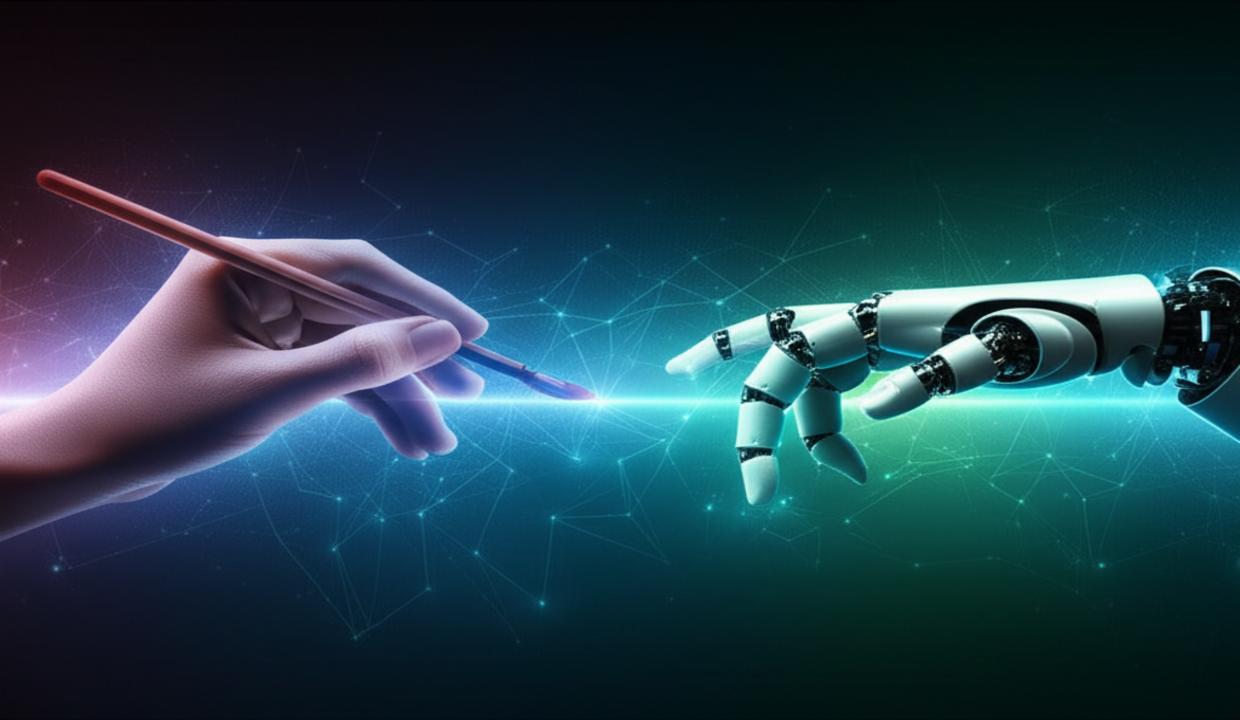
The dawn of artificial intelligence has sparked countless debates, but perhaps none is as profound and captivating as the discussion around AI vs Human Creativity. As advanced algorithms generate stunning art, compose intricate music, and even write compelling narratives, a fundamental question emerges: can technology truly replace human innovation? This isn’t just a theoretical exercise; it touches upon what it means to be human and the future of work, art, and problem-solving. We’re diving deep into the core differences, capabilities, and the exciting future where AI and human ingenuity might collaborate.
For centuries, creativity has been considered a uniquely human trait—a spark of genius born from consciousness, emotion, and personal experience. But with the rapid evolution of generative AI, these lines appear to blur. This article aims to explore these complex dynamics, demonstrating why, despite AI’s impressive strides, the essence of human innovation remains irreplaceable, driven by factors AI simply cannot replicate. Let’s unpack the intricate layers of this modern conundrum.
Understanding the Core Debate: AI vs Human Creativity
At the heart of the discussion lies a crucial distinction: what exactly do we mean by “creativity” when applied to both humans and machines? Human creativity is often viewed as a spontaneous, intuitive process, deeply intertwined with our conscious experiences, emotions, and personal aspirations. It’s about generating novel and valuable ideas, driven by an inherent desire to express, solve, or connect.
On the other hand, AI innovation, while producing results that appear creative, operates on a fundamentally different principle. It leverages sophisticated algorithms and vast datasets to recognize patterns, predict outcomes, and generate new combinations based on existing information. The debate isn’t whether AI can create, but whether its creations possess the same depth, intentionality, and emotional resonance as those born from a human mind.
The consensus among experts is clear: AI cannot truly replace human creativity and innovation because human creativity is deeply rooted in conscious experiences, emotions, intentionality, and social context, whereas AI creativity is based on pattern recognition from data without genuine understanding or emotions. This foundational difference shapes the entire landscape of AI vs Human Creativity.
The Distinctive Engines of Creativity: Human Intuition vs. AI Algorithms
One of the primary differentiating factors between human and AI innovation is their origin and the presence of consciousness. Human creativity doesn’t just happen; it arises from a rich tapestry of personal experiences, complex cognitive-emotional interplay, and a conscious drive to achieve specific goals or express profound meaning. Think of a painter driven by a personal loss or a scientist motivated by curiosity to solve a global challenge.
This deep, personal wellspring of inspiration, fueled by self-awareness and intentionality, is what distinguishes human creative output. Our ideas are often reflections of our inner world, our empathy, and our unique understanding of the human condition. We infuse our creations with layers of meaning that connect on a deeply human level, an element AI currently lacks.
In stark contrast, AI creativity emerges from the meticulous processing of large datasets. Algorithms like those in GPT-4 or DALL-E 3 analyze millions of images, texts, or sounds to learn patterns and then generate new outputs that mimic or combine these patterns. While impressive, this process lacks conscious intent, personal experience, or self-awareness. It’s a sophisticated form of recombination, not genuine understanding or feeling.
The ability of humans to form concepts beyond their training data, driven by intuition and imagination, marks a critical divergence. AI is a masterful mimic and synthesist, but its “novelty” is fundamentally tied to its data and algorithms, creating sophisticated remixes rather than entirely new paradigms that break free from all prior knowledge.
The Indispensable Role of Emotion and Intent in Human Creativity
Perhaps the most poignant distinction in the AI vs Human Creativity debate lies in the emotional connection. Humans imbue their creative works with personal significance. A piece of music can convey profound grief, a novel can capture the joy of discovery, or a painting can express a social critique. These works resonate with others because they tap into shared human emotions and experiences.
When we engage with human art or innovation, we often feel a connection to the creator’s intent and emotional landscape. This creates a powerful bond, a sense of shared humanity that enriches the experience. AI, by its very nature, lacks emotions and personal experiences. It can process and mimic emotional language or visual cues from its data, but it doesn’t truly understand or feel the emotions it simulates. For a deeper dive into this, you can read more about the difference between human and generative AI creativity.
Therefore, while an AI might generate a melancholy poem, it doesn’t feel melancholy itself. This absence of genuine emotional depth and intentionality means that while AI can replicate the form of creative expression, it cannot replicate the soul or the profound personal meaning that underpins the greatest works of human innovation. This emotional void is a major factor limiting AI replacement in fields requiring genuine empathy and personal connection.
Evaluating Creative Output: Where AI Shines and Humans Excel
It’s undeniable that AI has made astonishing progress in generating creative outputs. Studies, such as those using the alternate uses task (where participants list unusual uses for everyday objects), have shown that AI chatbots can often outperform average humans in generating a high volume of novel and diverse ideas very quickly. This speed and breadth are areas where AI innovation truly shines.
However, when it comes to the very best human creative outputs, AI still struggles to match or exceed them. The most groundbreaking human innovations often possess a unique nuance, an unpredictable quality, or a profound insight that AI’s algorithmic nature finds difficult to replicate fully. These are the “eureka” moments that spring from intuition, a deep understanding of context, and a touch of human brilliance that defies computational logic.
Human creators can break conventional molds in ways that AI, relying on existing patterns, cannot. The top echelon of human artistic, scientific, and design work continues to set benchmarks that reflect an intangible, often revolutionary quality. This suggests that while AI is excellent at augmenting the creative process, the pinnacle of creative achievement remains a human domain. To understand more about this ongoing competition, explore insights on which one will win in AI vs human creativity.
AI as an Augmentative Force, Not a Replacement
Given these fundamental differences, the prevailing expert view is not one of AI replacement, but rather one of complementarity. Instead of fearing that AI will take over, the focus shifts to how AI can augment and enhance human creativity. AI excels at tasks that support the creative process, such as:
- Idea Generation: Quickly brainstorming a vast array of concepts, helping humans overcome creative blocks.
- Accelerating Routine Tasks: Automating repetitive aspects of creation, like initial drafts, formatting, or basic data analysis, freeing up human creators for higher-level thinking.
- Democratizing Innovation: Providing powerful tools to individuals who might not have had access to traditional resources, lowering barriers to entry for creative fields.
- Enabling New Forms of Experimentation: Allowing creators to rapidly prototype and test diverse iterations of their ideas.
AI’s capacity to synthesize massive pools of information and identify obscure connections can indeed overcome organizational creativity bottlenecks. However, it still lacks the human insight, emotional depth, and contextual understanding necessary for truly meaningful and impactful innovation. This perspective sees AI as a powerful co-pilot, not an autonomous driver, in the journey of creation. Harvard Business Review discusses how generative AI can augment human creativity.
Glimpses into 2025: Observing the Synergy
As we move further into the decade, the discourse around AI vs Human Creativity continues to evolve. The year 2025 is already seeing more refined tools and deeper collaborations. A recent YouTube video from 2025 titled “AI vs Human Creativity: Who Wins?” by TechExplained 2025 brilliantly illustrates this ongoing debate.
The video showcases various examples of AI-generated art compared with human art, offering a visual testament to AI’s capabilities and its limitations. It concludes that while AI is an incredibly powerful tool, the true essence of creativity, particularly when considering emotional depth, personal narrative, and conscious intentionality, remains an intangible human trait. This reinforces the idea that the future of creativity is likely a partnership, not a takeover.
The Future Landscape: Hybrid Models and Collaborative Innovation
The most promising path forward lies in cultivating hybrid models—a symbiotic relationship where humans and AI collaborate. This approach harnesses the computational power and data processing capabilities of AI while preserving and elevating uniquely human insights, emotional intelligence, and contextual understanding. Imagine designers using AI to generate hundreds of initial concepts, then applying their human judgment and aesthetic sense to refine and imbue them with meaning.
This collaboration allows humans to focus on the strategic, conceptual, and emotional aspects of creation, tasks where they inherently excel. AI can handle the repetitive, data-intensive, and rapid prototyping elements. This doesn’t diminish human creativity; it amplifies it, allowing creators to explore new frontiers and push boundaries that might have been inaccessible before. For more insights on this blend, consider AI vs creativity in the modern era.
Ultimately, the future of creativity is not about AI replacing humans, but about humans leveraging AI to become even more creative, innovative, and impactful. It’s about designing new workflows and fostering environments where this powerful technology serves as an enabler, expanding the horizons of what’s possible in human innovation.
Key Distinctions: Human vs. AI Creativity
| Human Creativity | AI Creativity |
|---|---|
| Rooted in conscious experiences, emotions, and personal intent. | Based on pattern recognition from vast datasets without genuine understanding. |
| Driven by empathy, intuition, imagination, and social interaction. | Driven by algorithms, statistical relationships, and computational power. |
| Generates truly novel ideas, often breaking from prior knowledge. | Generates new combinations or recombinations of existing patterns. |
| Infuses creations with emotional depth, personal significance, and meaning. | Mimics emotional content but lacks genuine feeling or understanding. |
| Slow, often unpredictable, highly nuanced, and sometimes inefficient. | Fast, highly efficient, consistent, and predictable within its parameters. |
| Responsible for the “why” and “what for” of creation. | Excellent at the “how” and “what to generate next” based on data. |
Watch More on This Debate
Curious to see AI vs Human Creativity in action? Dive into the discussion with this insightful video:
(Note: Replace “your_video_id_here” with the actual YouTube video ID for “AI vs Human Creativity: Who Wins?” by TechExplained 2025.)
FAQ
- Can AI truly create original ideas?
While AI can generate outputs that appear novel, its “originality” is a recombination of existing patterns learned from its training data. Unlike humans who can conceptualize beyond prior knowledge through intuition and imagination, AI’s creativity is bounded by its datasets and algorithms. It’s more of a sophisticated synthesis than true, unprompted originality. - Is AI a threat to creative jobs?
Rather than a direct threat leading to AI replacement, AI is seen as a transformative tool. It will likely change the nature of creative jobs, automating mundane tasks and enabling new forms of expression. Creative professionals who learn to collaborate with AI will likely find themselves more efficient and innovative, focusing on higher-level conceptual and emotional aspects. - How can humans best leverage AI for creativity?
Humans can leverage AI by using it as a powerful assistant for brainstorming, rapid prototyping, automating repetitive tasks, and exploring vast datasets for inspiration. By treating AI as a tool that extends human capabilities, creators can achieve greater speed, breadth, and scale in their creative endeavors, ultimately enhancing their own human innovation. - What is the primary difference between human and AI creativity?
The primary difference lies in consciousness, emotion, and intentionality. Human creativity springs from personal experiences, feelings, and a conscious drive to express meaning. AI creativity, conversely, is a data-driven process of pattern recognition and generation, devoid of genuine understanding, emotion, or self-awareness. - Will AI ever gain consciousness and true creative intent?
The question of AI consciousness is a highly complex philosophical and scientific debate. Currently, there is no evidence or consensus that AI possesses consciousness or genuine creative intent. Its “understanding” is statistical, not experiential. While AI technology continues to advance rapidly, achieving consciousness remains a profound challenge and a distant prospect, if at all possible.
Conclusion
The journey through the intricate world of AI vs Human Creativity reveals a compelling truth: while AI is an unparalleled tool for augmentation and efficiency, it cannot truly replace the profound, emotionally resonant, and conscious act of human creation. The unique blend of personal experience, emotion, intention, and intuition forms the bedrock of human innovation—elements that current AI, operating on algorithms and data, simply does not possess.
The future of creativity is not a battle for dominance, but a collaboration. By embracing hybrid models, we can harness AI’s immense analytical and generative capabilities to amplify human ingenuity, allowing us to push the boundaries of art, science, and problem-solving in unprecedented ways. The most exciting innovations will likely come from the synergy of human insight and AI power, paving the way for a richer, more dynamic creative landscape. #FutureOfAI
What are your thoughts on this fascinating topic? Share your comments below, or read other articles on our site to continue exploring the impact of technology. You can also learn more About Us or Contact our team with any questions.
Watch More in This Video
Disclaimer: All images and videos are sourced from public platforms like Google and YouTube. If any content belongs to you and you want credit or removal, please inform us via our contact page.