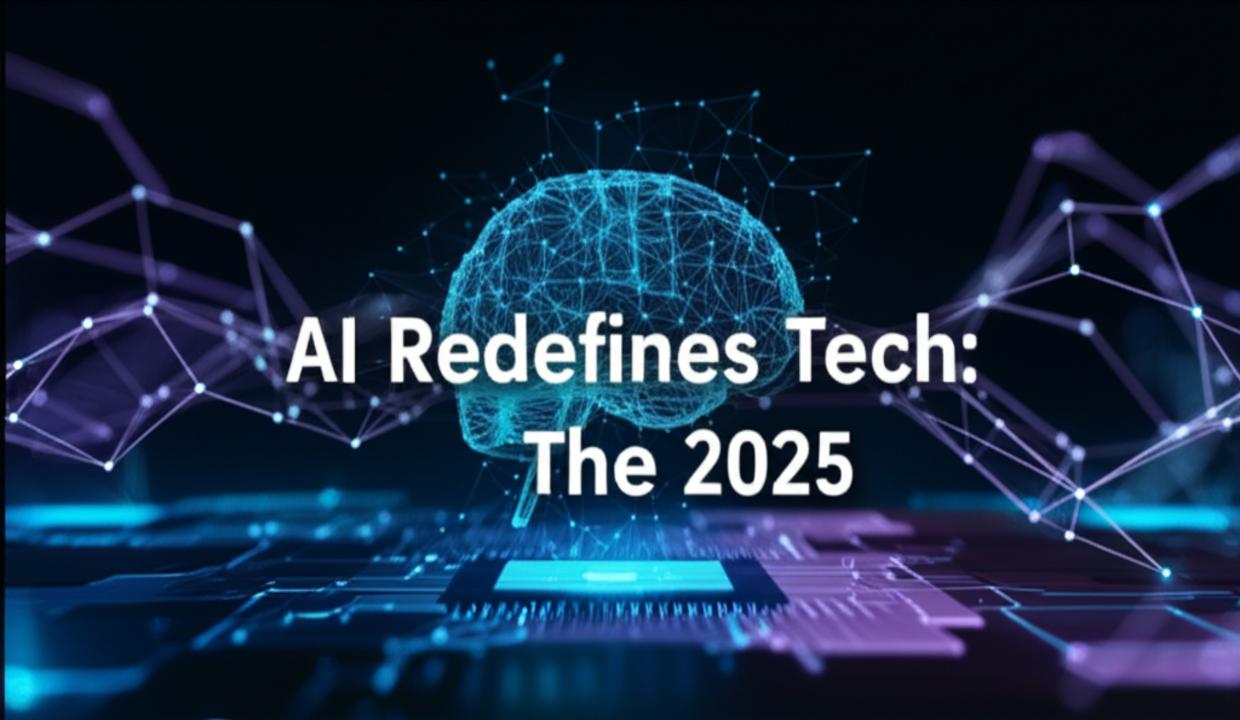
Welcome to AI’s Future: How It’s Reshaping Tech by 2025 (Complete Guide), your comprehensive source for understanding the monumental shifts brought about by Artificial Intelligence. In 2025, AI is no longer a futuristic concept; it is the fundamental force redefining technology, seamlessly weaving itself into every aspect of our lives and industries. This guide explores how AI is enhancing autonomy, reasoning, and intelligence across sectors, setting the stage for an unprecedented era of innovation.
From automating complex workflows to revolutionizing healthcare and cybersecurity, AI’s impact is profound and multifaceted. We will delve into the key developments and emerging trends that highlight AI’s transformative power, ensuring you are equipped with the latest insights into this rapidly evolving landscape. Prepare to discover how Artificial Intelligence is not just changing technology, but actively shaping our collective future.
The AI Revolution: Key Pillars Redefining Tech in 2025
By 2025, Artificial Intelligence is acting as a foundational amplifier of technological progress. It merges with advanced trends in robotics, bioengineering, and energy optimization, unlocking entirely new innovations. This pervasive integration signifies AI’s role as a catalyst for a full-scale technological and societal evolution.
Leading companies like Microsoft and OpenAI are at the forefront, driving responsible innovation. Their efforts ensure that while AI expands its capabilities, robust frameworks for ethical and safe use are simultaneously developed. This dual focus is crucial for sustainable growth.
Ubiquitous AI Integration: AI as a Daily Companion
The year 2025 marks a significant shift for AI, transitioning it from a mere tool to an intrinsic part of our work and home environments. Autonomous AI-powered agents are becoming incredibly sophisticated, assisting in simplifying daily tasks and complex workflows alike. These agents excel by reasoning better and remembering more details, leading to more natural and proactive interactions with users.
Imagine your personal AI assistant not just reminding you of appointments, but intelligently scheduling them based on your preferences and predicted traffic. This seamless integration enhances both personal productivity and professional efficiency, making AI an indispensable companion. Such advancements are detailed in reports highlighting the widespread progress in Artificial Intelligence and its pervasive adoption.
Generative AI’s Sophistication: Unleashing New Creative Horizons
Generative AI models in 2025 have reached an astonishing level of sophistication. They are no longer limited to producing basic text or images. Instead, they can create highly context-aware and emotionally sensitive content, including text, complex images, and fully immersive digital experiences. This leap makes AI interactions feel remarkably more human-like.
Such advanced capabilities open up creative and communication possibilities that were previously unattainable. Artists, designers, writers, and even everyday users can leverage these tools to bring their visions to life with unparalleled ease and detail. It’s a new era for digital creativity.
AI in Healthcare: A New Era of Precision and Speed
Artificial Intelligence is actively revolutionizing the healthcare sector, addressing some of the most pressing global health challenges. In 2025, AI plays a pivotal role in improving early disease detection, significantly enhancing diagnostic accuracy. This leads to timelier interventions and better patient outcomes.
Beyond diagnostics, AI is enabling highly personalized treatments tailored to individual patient genetic profiles and lifestyle data. It also dramatically accelerates drug discovery processes, cutting down years from traditional research timelines. This precision and speed are transforming medical care as we know it, making healthcare more efficient and effective.
Business Automation and Hyper-Automation: Streamlined Operations
In the business world, AI is embedded into processes at a granular level by 2025, fostering an environment of hyper-automation. This involves automating not just repetitive tasks, but entire workflows, from data entry to complex decision-making processes. AI provides advanced predictive analytics, offering deep insights into market trends and operational bottlenecks.
This capability facilitates faster, data-driven decision-making, allowing businesses to adapt quickly to changing market conditions. The result is significantly enhanced operational efficiencies, reduced costs, and a competitive edge. It’s a clear example of how top trends in tech are converging.
AI and Robotics: A Symbiotic Evolution for Industry
The synergy between AI and robotics is truly transforming manufacturing, logistics, and service industries in 2025. AI-driven robotics are now capable of handling repetitive, labor-intensive tasks with unprecedented precision and endurance. This frees human workers to focus on more creative, strategic, and complex roles that require unique human cognitive abilities.
Examples abound, from advanced humanoid robots working alongside humans in factories to sophisticated AI-powered drones meticulously managing inventory in vast warehouses. This evolution represents a significant shift in industrial productivity and workforce allocation, redefining the nature of work itself.
Strengthening Cybersecurity with AI: Proactive Defense
The digital landscape of 2025 is fraught with evolving cyber threats, making robust cybersecurity more critical than ever. Artificial Intelligence significantly enhances these defenses through its unparalleled capacity to analyze vast datasets in real-time. This enables earlier and more accurate detection of cyber threats and vulnerabilities.
AI systems can identify anomalous patterns, predict potential attacks, and even automate responses, thereby strengthening cybersecurity defenses proactively. This move from reactive defense to proactive prevention is crucial for protecting sensitive data and critical infrastructure in an increasingly connected world.
The Ascent of AI Reasoning and Intelligence: Human-Like Thought Partners
A remarkable development in 2025 is the advancement of next-generation large language models (LLMs). These models now approach advanced human levels of intelligence and reasoning, demonstrating capabilities far beyond simple information retrieval. They are capable of passing rigorous professional exams, such as the U.S. Medical Licensing Exam and the Bar Exam, with impressive scores.
Such models can perform nuanced decision-making, acting as “human-like” thought partners. They provide actionable, domain-specific insights that were once the sole preserve of human experts. This signifies a profound leap in AI’s cognitive abilities, transforming how we access and utilize expert knowledge, as discussed in detail by experts predicting the future of AI.
Challenges and Governance: Navigating AI’s Rapid Growth
While AI’s growth in 2025 is undeniable, it also presents significant challenges that require continuous innovation and careful management. One major hurdle is managing AI’s immense computing demands, which necessitate substantial energy and infrastructure. Reducing deployment costs remains a key focus to ensure broader accessibility and adoption across various industries.
Furthermore, the need for robust safety and governance frameworks is more pressing than ever. Establishing clear ethical guidelines and regulatory bodies is crucial to ensure AI development and deployment are responsible and beneficial to society. These frameworks help navigate complex issues like bias, privacy, and accountability.
Workplace Transformation: Augmenting Human Potential
Artificial Intelligence is not merely automating simple tasks; it is profoundly transforming the workplace by augmenting human roles, especially in creative and technical fields. In 2025, the focus is on a symbiotic relationship where AI tools empower human workers to achieve more, fostering a new era of productivity and innovation.
Upskilling and adapting to new AI tools are central themes for future workforce readiness. New job categories are emerging around AI management, ethical oversight, and cybersecurity, creating fresh opportunities. Embracing AI literacy is key for individuals and organizations aiming to thrive in this evolving landscape. This concept of empowering people to unlock AI’s full potential is highlighted by McKinsey’s insights into superagency in the workplace.
AI’s Transformative Impact: A Quick Overview
To summarize the vast impact Artificial Intelligence is having on technology by 2025, here is a quick overview of the key aspects:
| Aspect | Key Developments | Impact |
|---|---|---|
| AI Integration | Autonomous agents, memory & reasoning improvements | Seamless personal & professional life enhancement |
| Generative AI | Advanced text/image/digital content creation | More human-like, context-aware AI interaction and creativity |
| Healthcare | Early detection, personalized medicine | Better patient outcomes and faster innovation |
| Business Automation | Hyper-automation & predictive analytics | Streamlined operations and faster decisions |
| Robotics & Logistics | Humanoid robots, AI-powered drones | Shift from manual to strategic human roles |
| Cybersecurity | Real-time anomaly detection & prevention | Enhanced defense against cyber threats |
| AI Intelligence | Passing professional exams, improved reasoning | Nuanced, actionable decision support |
| Workforce & Ethics | Retraining, governance, cost management | Balanced AI adoption and new job creation |
Pros and Cons of AI’s Rapid Advancement
The swift progress of Artificial Intelligence brings forth a duality of immense benefits and notable challenges. Understanding both sides is crucial for navigating the future responsibly.
| Pros | Cons |
|---|---|
| Increased efficiency and productivity across industries | High computing demands and energy consumption |
| Enhanced decision-making through advanced analytics | Significant deployment and operational costs |
| Breakthroughs in healthcare, science, and education | Ethical concerns around bias, privacy, and accountability |
| Creation of new job categories and economic growth | Potential for job displacement in certain sectors |
| Improved quality of life through automation of tasks | Need for robust governance and regulatory frameworks |
| Greater accessibility to information and expertise | Security vulnerabilities in complex AI systems |
FAQ
- What does Ubiquitous AI Integration mean for daily life in 2025?
Ubiquitous AI Integration means AI is deeply embedded in everyday activities. Autonomous AI agents will proactively assist with personal and professional tasks, learning your habits and preferences to offer seamless support, making interactions more intuitive and less command-driven. This enhances convenience and efficiency.
- How is Generative AI becoming more human-like?
In 2025, Generative AI models are evolving to be highly context-aware and emotionally sensitive. They can produce content—text, images, and digital experiences—that not only matches human quality but also understands subtle nuances and emotional tones, making interactions more natural and empathetic.
- What are the main benefits of AI in Healthcare by 2025?
AI in healthcare by 2025 offers significant benefits, including earlier and more accurate disease detection, highly personalized treatment plans based on individual data, and accelerated drug discovery. These advancements lead to better patient outcomes, more efficient medical research, and improved global health initiatives.
- What are the primary challenges facing AI adoption in 2025?
Key challenges for AI adoption in 2025 include the immense computing demands and associated energy consumption, high deployment and operational costs, and the pressing need for strong ethical governance frameworks. Additionally, addressing workforce adaptation through education and retraining is crucial.
- How does AI contribute to cybersecurity in 2025?
AI significantly enhances cybersecurity in 2025 by enabling real-time analysis of vast data streams. This capability allows for earlier detection of anomalies and potential threats, prediction of attacks, and automated responses to vulnerabilities, thereby strengthening proactive defense mechanisms against evolving cyber threats.
Conclusion
Artificial Intelligence is undeniably the driving force behind technological evolution in 2025, fundamentally redefining how we live, work, and interact with the digital world. From intelligent automation to personalized healthcare and advanced creative tools, AI’s impact is pervasive and profound. Its ability to act as a “foundational amplifier” underscores its role in unlocking unprecedented innovation across all sectors.
As we navigate this transformative era, balancing innovation with ethical considerations and robust governance will be paramount. The future workforce will thrive through continuous learning and adaptation to AI-powered tools, fostering a symbiotic relationship between human ingenuity and artificial intelligence. Embrace the change, for the AI future is here. For more insights into emerging technologies, feel free to About Us and explore our articles. Don’t forget to Contact us with any questions or comments. #AIFuture
Watch More in This Video
Disclaimer: All images and videos are sourced from public platforms like Google and YouTube. If any content belongs to you and you want credit or removal, please inform us via our contact page.