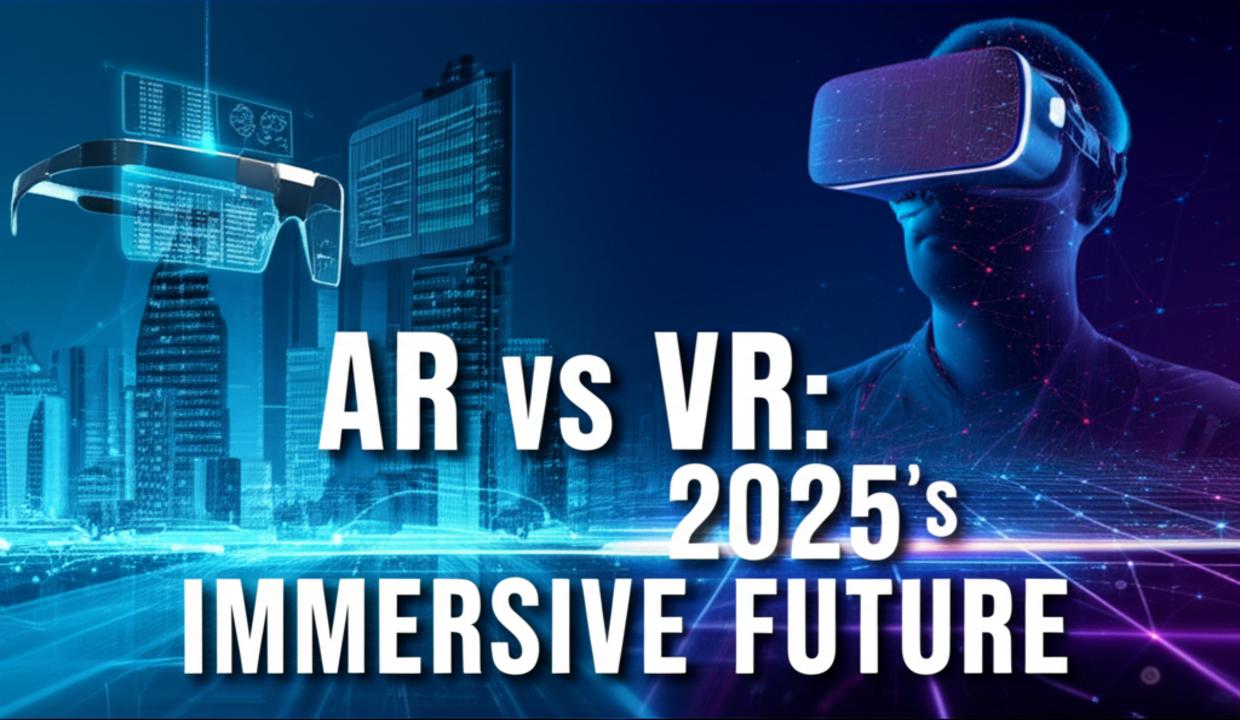
The landscape of immersive tech is rapidly evolving, with AR glasses and VR headsets leading the charge into a future where digital and physical realities seamlessly merge. As we edge closer to 2025, the question isn’t just about which technology will triumph, but how each is carving out its unique niche.
This article delves deep into the anticipated advancements and market positions of both augmented reality and virtual reality devices. We will explore their key features, applications, and the exciting new innovations revealed at events like CES 2025. Get ready to understand the dynamic future of AR vs VR.
Main Highlights: AR Glasses vs VR Headsets in 2025
By 2025, we won’t see a single dominant technology, but rather a sophisticated ecosystem where AR glasses and VR headsets play complementary roles. Each will excel in specific use cases, enhancing different aspects of our daily lives and professional endeavors.
VR headsets will continue to be the champions of full immersion, perfect for escaping into virtual worlds. Meanwhile, AR glasses are set to integrate digital information directly into our physical surroundings, making them invaluable for both work and casual use. Explore the nuanced differences and shared future of these technologies.
VR Headsets: The Apex of Full Immersion
VR headsets are poised to maintain their lead in delivering truly immersive experiences by 2025. Their ability to entirely replace the user’s reality makes them ideal for demanding applications. Think thrilling gaming, intricate training simulations, and expansive metaverse social platforms.
New models arriving in 2025 promise even crisper visuals and stronger processing power. Many are also embracing mixed reality features through advanced pass-through cameras. This allows a blend of the virtual with glimpses of the real world, adding versatility.
The price range for VR headsets will be broad, increasing accessibility for everyone. You’ll find affordable entry-level sets around $300, while high-end professional rigs might reach up to $3,000. This diversity ensures a headset for every need and budget.
AR Glasses: Seamlessly Blending Digital with Reality
AR glasses are undergoing a significant transformation, evolving into sleek, lightweight designs that closely resemble normal eyewear. A key focus for 2025 is full-day battery life and intuitive, natural gesture controls, prioritizing user comfort and daily usability.
Innovations like AI-powered contextual overlays are making AR glasses smarter, providing information exactly when and where you need it. Spatial audio enhances the digital overlay experience, while real-time environment recognition ensures seamless integration with your surroundings.
These features make AR glasses exceptional for enterprise applications, such as manufacturing, logistics, and on-demand information access. For casual users, they’ll revolutionize navigation, social media interaction, and access to contextual data throughout the day.
The Blurring Lines: Rise of Mixed Reality (MR)
The concept of Mixed Reality (MR) is gaining substantial traction, effectively blurring the lines between AR glasses and VR headsets. MR devices skillfully incorporate elements from both, creating environments that are both immersive and context-aware.
This hybrid approach is becoming particularly valuable for professional work and creative tasks. Hardware improvements, such as all-in-one, wireless headsets with embedded processors, are driving MR’s ascent. These advancements make MR more accessible and powerful than ever.
The synergy offered by MR devices allows users to interact with digital content within their physical space, or seamlessly transition to a fully virtual environment. It represents a versatile bridge between the two distinct forms of immersive tech.
Market Dynamics: Who’s Adopting What by 2025?
The market outlook for 2025 indicates distinct adoption patterns for each technology. Consumer adoption of VR headsets will continue to be driven primarily by engaging gaming experiences and immersive entertainment. The allure of escaping into rich, virtual worlds remains a powerful draw.
Conversely, AR glasses are expected to make significant inroads in enterprise and mobile daily-use scenarios. Their ability to augment reality without fully replacing it makes them perfect for practical applications in various industries. This includes manufacturing, healthcare, and retail.
The advent of spatial computing, exemplified by devices like Apple’s Vision Pro, signals a broader paradigm shift. This technology is enabling more integrated digital-physical experiences, pushing both AR and VR towards a unified, interactive digital layer over our world. You can read more about emerging trends in AR and VR technology in 2025.
Innovations in 2025: AI and Enhanced Sensory Experiences
Artificial Intelligence (AI) is set to revolutionize both VR headsets and AR glasses by 2025. AI-powered generation of dynamic content will automate the creation of immersive environments, significantly reducing development time. This means richer, more personalized experiences for users.
Beyond visuals, sensory advances are enhancing immersion. Spatial audio, for instance, provides a more realistic and engaging soundscape, making virtual objects sound like they’re truly present. Biometric feedback, such as heart rate and facial tension, will enable devices to adapt experiences based on user emotions, deepening engagement.
These intelligent integrations will make interactions with immersive tech feel more natural and responsive. Whether in a virtual world or augmented reality, the devices will understand and react to the user in unprecedented ways. This pushes the boundaries of what’s possible in future tech 2025.
Spotlight on CES 2025: Groundbreaking Devices
The Consumer Electronics Show (CES 2025) provided a tantalizing glimpse into the future of AR vs VR. Several devices stood out, showcasing the rapid advancements in both fields. These innovations reinforce the idea of a diversified, complementary market.
- Rokid AR Spatial Glasses: These glasses received accolades for their gaming prowess at CES 2025. They offer massive virtual displays linked to gaming devices, transforming how users interact with their favorite titles. This highlights AR’s potential in entertainment.
- Xreal One Pro: This device exemplifies the evolution of AR eyewear with its enhanced displays and improved comfort. It represents a clear trend towards premium, user-friendly AR wearables that blend seamlessly into daily life.
These highlights underscore the commitment of manufacturers to push the boundaries of both virtual and augmented reality. They demonstrate the clear path towards more accessible, powerful, and comfortable AR glasses and VR headsets.
Performance and User Experience: A Direct Comparison
When comparing performance, VR headsets excel in providing a completely isolated, high-fidelity digital world. Their powerful processors and high-resolution displays are optimized for graphics-intensive applications like photorealistic games and detailed simulations. The goal is complete sensory immersion.
AR glasses, on the other hand, prioritize seamless integration and real-world awareness. Their performance is measured by how accurately and responsively they can overlay digital information onto your view without obstructing it. Low latency and precise tracking are paramount for a natural augmented experience.
User experience also differs significantly. VR offers escapism and deep engagement within virtual environments. AR focuses on enhancing daily tasks and interactions, providing contextual information or tools without disconnecting you from your physical surroundings. Both are distinct forms of immersive tech, each with a unique purpose.
Design, Comfort, and Daily Usability
Design and comfort are paramount for both types of devices, especially as they become more integrated into our lives. VR headsets, while still relatively bulky due to the need for total occlusion, are becoming lighter and better balanced. Improved ergonomics and weight distribution enhance comfort for longer sessions.
AR glasses are on a trajectory towards near-normal eyewear aesthetics by 2025. Sleek frames, lightweight materials, and discreet technology are key. The goal is for them to be worn for extended periods, almost unnoticeably, much like regular spectacles. This focus on form factor is crucial for mass adoption.
Daily usability is where AR glasses truly shine, offering always-on access to digital overlays for navigation, notifications, or quick information lookups. VR headsets, while becoming more convenient with wireless designs, remain more geared towards dedicated sessions in specific environments. Explore the latest trends in smart glasses and MR headsets for 2025-2026.
Pricing and Accessibility: Investing in Immersive Tech
The pricing landscape for immersive tech in 2025 will offer options for almost every consumer and business. VR headsets will continue to span a wide spectrum. Entry-level models, such as those ideal for casual gaming, are expected to remain around $300, making them quite accessible.
Mid-range and high-end VR headsets, boasting advanced features, greater processing power, and specialized optics, could range from $800 to upwards of $3,000. These higher-priced units often target professional users, serious gamers, and enterprise training applications.
AR glasses, particularly the more advanced models with sophisticated AI and display technology, are likely to start at a higher price point than entry-level VR. However, as the technology matures and manufacturing scales, more affordable consumer-focused AR glasses will emerge. Premium models, like those showcased at CES 2025, could also command a significant investment. For those looking for everyday use, finding the best smart glasses will be key.
Pros and Cons: AR vs. VR in 2025
| Pros | Cons |
|---|---|
|
|
Expert Outlook: The Future Trajectory of Immersive Tech
Experts agree that 2025 will not crown a single victor in the AR vs VR debate. Instead, the year will solidify their distinct and complementary roles. VR headsets are set to deepen their dominance in fully virtual, high-immersion environments. This includes leading the charge in gaming, professional training, and the burgeoning metaverse spaces.
Conversely, AR glasses are projected to become indispensable for augmenting daily activities and enhancing enterprise functions. Their lighter form factor and ability to provide always-on contextual data make them perfect companions for navigating the real world. This reflects a shift towards pragmatic, integrated digital assistance.
Mixed reality devices will continue to grow as versatile tools. They will bridge the gap between these two worlds, offering unique solutions for work and creative tasks. The overall ecosystem will expand, with each technology fulfilling specific needs, all powered by advancements in AI, hardware miniaturization, and sophisticated sensory integration. The #FutureIsNow for these incredible technologies, shaping our digital and physical interaction.
Watch CES 2025 Highlights: Top VR & AR Devices
Frequently Asked Questions About AR & VR in 2025
-
Will AR glasses replace VR headsets by 2025?
No, by 2025, AR glasses are not expected to replace VR headsets. Instead, they will serve complementary functions. VR will dominate fully immersive experiences like gaming, while AR will excel in augmenting daily life and enterprise tasks by overlaying digital info on the real world.
-
What are the main applications for VR headsets in 2025?
In 2025, VR headsets will primarily be used for high-immersion activities. These include advanced gaming, realistic training simulations across various industries, and engaging with social platforms within the metaverse. They offer complete escapism into virtual environments.
-
How are AR glasses becoming more user-friendly by 2025?
By 2025, AR glasses are evolving with sleek, lightweight designs resembling normal eyewear. Key advancements include full-day battery life, natural gesture controls, and AI-powered contextual overlays. These features significantly improve user comfort and daily usability, making them more integrated into everyday life.
-
What is Mixed Reality (MR) and its role in 2025?
Mixed Reality (MR) devices blur the lines between AR and VR. By 2025, MR will gain traction as versatile tools providing immersive yet context-aware environments. They are ideal for work and creative tasks, allowing seamless interaction with digital content within or beyond physical space.
-
What pricing can I expect for AR and VR devices in 2025?
Prices in 2025 will vary widely. Entry-level VR headsets might start around $300, with professional rigs reaching $3,000. Advanced AR glasses will likely start higher, but more affordable consumer models are expected to emerge as the market matures and technology scales.
-
How will AI impact AR and VR experiences in 2025?
AI will significantly enhance both AR and VR in 2025. It will automate the generation of dynamic content for immersive environments, reduce development time, and enable richer, more personalized experiences. AI also powers contextual overlays in AR and allows for biometric feedback, deepening immersion.
Conclusion: A Complementary Future for Immersive Tech
The year 2025 will mark a period of significant growth and diversification for both AR glasses and VR headsets. Rather than one dominating the other, the future is clearly complementary. VR headsets will continue to be the go-to for deep, fully immersive escapes into virtual worlds, perfect for gaming, simulations, and the metaverse.
Meanwhile, AR glasses are poised to become indispensable tools for augmenting our everyday reality. Their sleek designs, AI-powered features, and focus on practical applications will redefine how we interact with digital information in the physical world. Mixed Reality will bridge these experiences, offering the best of both worlds.
The advancements in AI, hardware, and sensory integration ensure that both technologies will flourish, each serving crucial, distinct purposes. The future of immersive tech is not a battle for dominance, but a harmonious expansion of digital possibilities. We hope this deep dive into future tech 2025 has been insightful. Feel free to share your thoughts in the comments below, or learn more about us on our About Us page, and explore other articles!
Disclaimer: All images and videos are sourced from public platforms like Google and YouTube. If any content belongs to you and you want credit or removal, please inform us via our contact page.